




15 May 2026
The Next Agriculture Race Won’t Be About Production
For decades, global agriculture was driven by one dominant objective:
produce more.
Higher yields, larger supply chains, expanded production systems, and operational efficiency became the foundation of modern food systems. Governments invested heavily in agricultural output, industries optimized for scale, and innovation focused primarily on increasing productivity to meet rising global demand.
That model helped transform agriculture into one of the most efficient industries in the world.
But the next era of agriculture may be shaped by a very different challenge.
The future of global food systems may not depend solely on which countries, institutions, or industries can produce the most.
It may increasingly depend on which systems can adapt the fastest.
As climate volatility, resource stress, supply chain instability, biosecurity risks, and technological disruption continue accelerating globally, agriculture is entering a structural transition where resilience, predictive intelligence, sustainability, and adaptive infrastructure are becoming just as important as productivity itself.
Global Agriculture Is Entering a New Operating Environment
Modern food systems are operating under pressures that are becoming increasingly interconnected ( https://garcx.com/blogs/global-agriculture-needs-integration-not-just-innovation )
Climate change ( https://garcx.com/blogs/the-global-food-system-was-built-for-stability-the-future-wont-be )is affecting agricultural productivity worldwide. Extreme weather events, rising temperatures, prolonged droughts, floods, and changing rainfall patterns are creating growing uncertainty across global farming systems.
According to the United Nations, the global population is projected to reach nearly 9.7 billion by 2050, increasing pressure on food production, water resources, and agricultural infrastructure worldwide.
At the same time, the Food and Agriculture Organization (FAO) estimates that agriculture already accounts for approximately 70% of global freshwater withdrawals, highlighting the increasing importance of sustainable resource management and climate-smart agriculture.
Food systems are also becoming more vulnerable to:
- supply chain disruptions
- soil degradation
- livestock disease outbreaks
- rising production costs
- geopolitical instability
- environmental stress
- labor shortages
- resource scarcity
These pressures are reshaping how governments, researchers, agribusinesses, investors, and policymakers think about the future of agriculture and food security.
The challenge is no longer only about producing more food.
It is increasingly about maintaining stability under uncertainty.
Why Productivity Alone Is No Longer Enough
For decades, agricultural success was largely measured through output and efficiency.
Higher production meant stronger systems.
But today’s global environment is exposing the limitations of models optimized primarily for scale.
Highly efficient can become structurally vulnerable during periods of disruption.
Recent global events have demonstrated how quickly food systems can be affected by:
- climate-related disasters
- transportation bottlenecks
- energy price fluctuations
- disease outbreaks
- trade disruptions
- geopolitical conflicts
For example, climate-related disruptions are projected to significantly impact agricultural productivity in multiple regions over the coming decades. Research from the World Bank suggests climate change could reduce crop yields by up to 30% in some regions by 2050 if stronger adaptation strategies are not implemented.
This is changing the global agriculture conversation.
The future of food systems may depend not only on how efficiently systems operate during stable conditions, but also on how effectively they respond during periods of volatility.
That distinction is becoming increasingly important.
Because resilient systems are fundamentally different from optimized systems.
Optimized systems maximize efficiency under predictable conditions.
Resilient systems maintain functionality during disruption.
And agriculture is entering an era increasingly defined by disruption.
The Rise of Resilient Agriculture Systems
Resilient agriculture systems are designed to adapt to environmental, economic, and operational uncertainty while maintaining long-term productivity and sustainability.
This includes strengthening:
- climate adaptability
- sustainable resource management
- diversified production systems
- predictive monitoring
- resilient infrastructure
- food supply chain flexibility
- ecosystem sustainability
- biosecurity preparedness
Governments and agricultural industries worldwide are expanding investments in climate-smart agriculture, regenerative farming systems, sustainable livestock management, and resilient food infrastructure as global food security challenges become increasingly complex.
This transition is also influencing how agricultural innovation itself is evolving.
The focus is moving beyond yield optimization alone toward building systems capable of operating sustainably under changing environmental conditions.
AI and Predictive Agriculture Are Reshaping Food Systems
Technology is becoming one of the most important drivers of future-ready agriculture systems.
Artificial intelligence, precision agriculture, predictive analytics, remote sensing, machine learning, and digital monitoring technologies are rapidly transforming how agricultural ecosystems are managed globally.
AI-enabled agriculture systems are helping improve:
- crop forecasting
- disease surveillance
- livestock health monitoring
- precision irrigation
- climate risk analysis
- resource optimization
- supply chain visibility
- sustainable production planning
Predictive agriculture technologies are becoming increasingly important as climate unpredictability and operational risks continue growing worldwide.
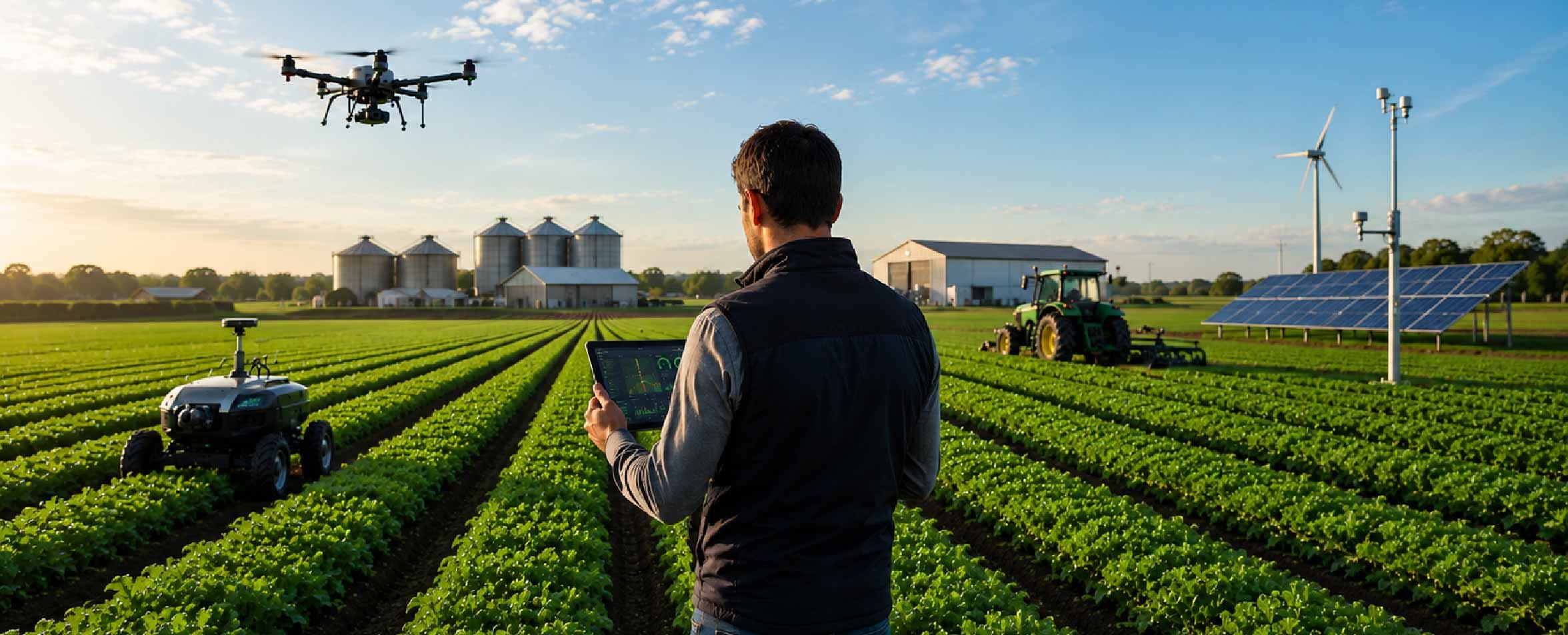
By integrating real-time environmental data, satellite monitoring, AI-driven analytics, and predictive intelligence systems, agriculture is shifting from reactive decision-making toward proactive resilience planning.
The global precision agriculture market is expected to grow significantly over the coming decade as countries and industries prioritize sustainable and data-driven farming systems.
This transformation is positioning agriculture as a far more technology-integrated industry than ever before.
Sustainability Is Becoming an Economic Strategy
Sustainability is no longer viewed only as an environmental responsibility.
It is increasingly becoming an economic and strategic necessity.
Consumers, governments, investors, food companies, and policymakers are placing greater emphasis on:
- sustainable agriculture
- transparent supply chains
- regenerative farming
- low-impact production systems
- climate resilience
- environmental accountability
- sustainable livestock ecosystems
This shift is accelerating investments in:
- climate-smart agriculture
- resilient food infrastructure
- sustainable farming technologies
- soil restoration systems
- precision agriculture
- integrated monitoring ecosystems
Countries and industries are increasingly recognizing that long-term agricultural competitiveness will depend not only on productivity, but also on how effectively systems manage environmental and operational risk
The Future of Agriculture Will Belong to Adaptive Systems
Agriculture is no longer operating as an isolated sector.
Modern food systems are becoming deeply interconnected with:
- climate science
- artificial intelligence
- public health
- environmental monitoring
- biotechnology
- infrastructure systems
- global trade networks
- sustainability policy
This transition is encouraging greater collaboration between researchers, policymakers, startups, institutions, innovators, and industry leaders working across multiple disciplines.
Around the world, conversations are increasingly focused on how agriculture can evolve into a more resilient, intelligent, sustainable, and adaptive ecosystem capable of supporting long-term food security under rapidly changing global conditions.
Platforms such as GARCX 2026, powered by ARCC Journals, are contributing to these evolving conversations through a virtual global platform focused on agriculture innovation, climate resilience, sustainable food systems, animal science, future-ready technologies, and integrated global agriculture ecosystems.
Because the next agriculture race may not be won by the systems producing the most.
It may ultimately be won by the systems adapting the fastest.
Frequently Asked Questions
The future of agriculture is shifting toward adaptive systems because global food systems are facing increasing climate volatility, water scarcity, supply chain instability, soil degradation, and resource pressure. Adaptive agriculture systems help improve resilience, sustainability, and long-term food security under changing global conditions.
AI is transforming agriculture through predictive farming, precision agriculture, crop monitoring, livestock health management, climate forecasting, disease detection, and resource optimization. Artificial intelligence helps agriculture become more efficient, sustainable, and data-driven across modern food systems.
Resilient food systems are systems designed to adapt to disruptions such as climate change, supply chain instability, disease outbreaks, and environmental stress while maintaining food production, sustainability, and operational stability.
Climate-smart agriculture refers to farming practices and technologies designed to improve agricultural productivity while increasing resilience to climate change and reducing environmental impact. Examples include precision irrigation, regenerative agriculture, predictive farming, and sustainable resource management.
Future food systems face challenges including climate change, water scarcity, soil degradation, population growth, supply chain disruptions, food security risks, environmental sustainability concerns, and increasing pressure on agricultural infrastructure globally.
SHARE :