




13 May 2026
The Global Food System Was Built for Stability. The Future Won’t Be.
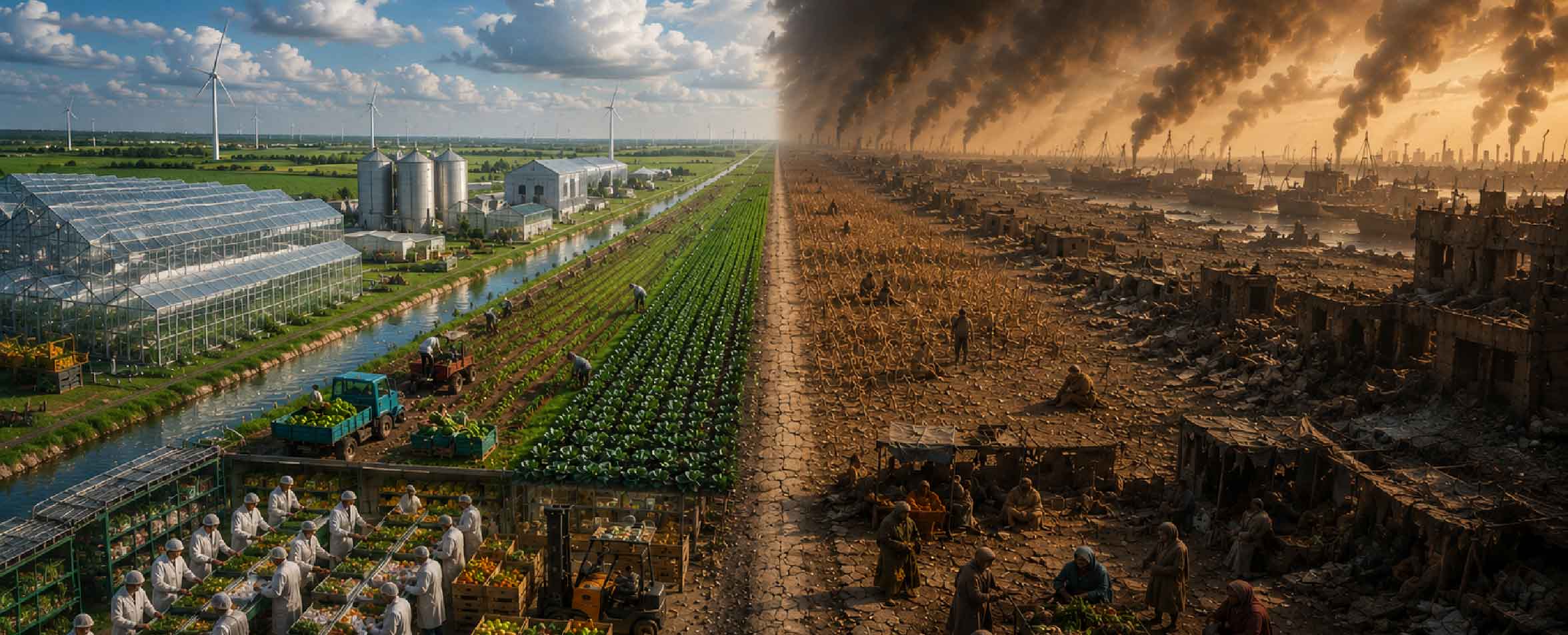
The global food system is entering one of the most significant transformation periods in modern history.
For decades, agriculture and food production systems were designed around relatively stable environmental conditions, predictable supply chains, and efficiency-driven operating models.Globalization accelerated agricultural trade, technological innovation improved productivity, and food systems scaled rapidly to meet growing demand.
However, the conditions shaping agriculture today are fundamentally different from those that shaped the systems currently in place.
Climate volatility is intensifying. Global supply chains are becoming increasingly fragile. Water scarcity is affecting agricultural productivity across multiple regions. Soil degradation continues to threaten long-term food security, while emerging disease risks and geopolitical disruptions are adding new layers of uncertainty to global food systems.
According to the United Nations, the global population is expected to reach nearly 9.7 billion by 2050, significantly increasing demand for food, water, energy, and agricultural resources.At the same time, the Food and Agriculture Organization (FAO) estimates that more than 30% of the world’s soils are already degraded, directly impacting crop productivity and ecosystem resilience.
The challenge facing agriculture is no longer simply about increasing production.
It is increasingly about building resilient, adaptive, and sustainable food systems capable of operating under uncertainty.
Agriculture Was Optimized for Efficiency — Not Volatility
Modern agriculture achieved remarkable progress by optimizing for scale and efficiency.
Over the past several decades, agricultural systems evolved to maximize:
- Productivity
- Operational consistency
- Supply chain speed
- Resource efficiency
- Global distribution capacity
These systems helped improve food accessibility and agricultural output worldwide. Advances in mechanization, precision farming, biotechnology, and livestock management significantly transformed global agriculture and enabled large-scale production models.
However, highly optimized systems can also become structurally vulnerable during periods of disruption.
Recent global events have demonstrated how interconnected and fragile food systems can become under pressure. Extreme weather conditions, transportation bottlenecks, rising energy costs, disease outbreaks, and geopolitical instability have disrupted food supply chains across multiple continents.
Climate-related disruptions alone are projected to have major economic consequences for agriculture. Research from the World Bank estimates that climate change could reduce global crop yields by up to 30% by 2050 in some regions if adaptation strategies are not strengthened.
The issue is not that food systems stopped functioning.
The issue is that many existing systems were designed for stability rather than long-term volatility.
And global agriculture is now entering an era increasingly defined by volatility.
Why Food Security Is Becoming a Systems Challenge
Historically, food security discussions focused primarily on agricultural production and yield growth.
Today, food security has become far more complex.
Modern food systems are influenced by interconnected factors including:
- Climate resilience
- Water availability
- Energy infrastructure
- Livestock health
- Biosecurity
- Logistics and transportation
- Trade stability
- Technological adoption
- Environmental sustainability
This shift is transforming food security from a production challenge into a systems-level challenge.
For example, drought conditions affecting one region can influence global commodity prices. Livestock disease outbreaks can impact international supply chains. Disruptions in shipping infrastructure can affect food accessibility thousands of miles away from production zones.
At the same time, agriculture is under growing pressure to reduce environmental impact while maintaining productivity and long-term sustainability.
According to the FAO, agriculture currently accounts for approximately 70% of global freshwater withdrawals, highlighting the increasing importance of sustainable resource management and climate-smart agricultural practices.
As a result, future-ready food systems will require greater adaptability, resilience, and integrated planning across multiple sectors.
The Growing Role of AI and Predictive Agriculture
Technology is rapidly reshaping the future of global agriculture.
Artificial intelligence, predictive analytics, precision agriculture, remote sensing, climate intelligence systems, and digital monitoring platforms are increasingly influencing how food systems operate.
AI-enabled agriculture is helping improve:
- Crop monitoring and forecasting
- Disease detection and surveillance
- Livestock health management
- Irrigation optimization
- Weather risk analysis
- Supply chain visibility
- Resource-use efficiency
The global precision agriculture market is projected to grow significantly over the coming decade as governments, agribusinesses, and producers invest in smarter and more sustainable farming systems.
Predictive agriculture technologies are becoming especially important in regions facing increasing climate variability. By combining satellite imagery, environmental monitoring, AI-driven analytics, and real-time field data, agricultural systems can become more proactive rather than reactive.
This transition represents a major shift in how agriculture approaches resilience and long-term sustainability.
The future of agriculture will increasingly depend not only on production capacity, but also on the ability to anticipate, adapt, and respond to rapidly changing conditions.
Climate Resilience Is Becoming an Economic Priority
Climate resilience is no longer viewed solely as an environmental issue.
It is increasingly becoming an economic, infrastructure, and food security priority.
Governments, research institutions, investors, and agribusinesses worldwide are expanding investments in:
- Climate-smart agriculture
- Regenerative farming systems
- Sustainable livestock management
- Resilient food infrastructure
- Precision irrigation technologies
- Soil restoration initiatives
- Integrated monitoring systems
The economic implications are substantial.
The global agri-tech market is expected to experience rapid growth as industries prioritize technologies capable of improving sustainability, efficiency, and climate adaptability simultaneously.
At the same time, consumers and policymakers are placing greater emphasis on food transparency, sustainability, and environmental accountability across agricultural supply chains.
This is accelerating the shift toward more resilient and data-driven agricultural ecosystems.
The Future of Agriculture Will Be Defined by Adaptability
Agriculture is no longer operating as an isolated sector.
Modern food systems are increasingly interconnected with:
- Climate science
- Artificial intelligence
- Public health
- Environmental monitoring
- Biotechnology
- Infrastructure systems
- Global trade networks
- Sustainability policy
This transition is encouraging greater collaboration between researchers, policymakers, institutions, startups, industry leaders, and innovation ecosystems working across multiple disciplines.
As global agriculture continues evolving, the focus is shifting beyond productivity alone toward resilience, adaptability, and long-term sustainability under uncertain conditions.
Platforms such as GARCX 2026 , powered by ARCC Journals , are contributing to these conversations by creating a virtual global platform focused on agriculture, food systems, animal science, climate resilience, sustainability, and future-ready innovation ecosystems.
Because the future of agriculture may not be shaped only by how efficiently systems operate.
It may ultimately be shaped by how intelligently they adapt to uncertainty.
Frequently Asked Questions
Global food systems are becoming more vulnerable due to climate change, supply chain disruptions, water scarcity, soil degradation, geopolitical instability, and increasing food demand. Many agricultural systems were originally designed for stable environmental and economic conditions, making adaptation increasingly important in today’s rapidly changing global landscape.
A resilient food system is a system capable of adapting to disruptions while continuing to maintain food production, supply chain stability, and resource efficiency. Resilient food systems often integrate climate-smart agriculture, predictive technologies, sustainable farming practices, and adaptive infrastructure to improve long-term food security.
Artificial intelligence is transforming agriculture through predictive analytics, crop monitoring, precision farming, disease detection, livestock management, weather forecasting, and resource optimization. AI-powered agriculture technologies help improve productivity, sustainability, and decision-making across modern food systems.
Climate resilience is important because agriculture is highly affected by extreme weather events, changing rainfall patterns, droughts, floods, and rising temperatures. Climate-resilient agriculture helps improve food security, protect natural resources, and strengthen long-term agricultural sustainability under changing environmental conditions.
Climate-smart agriculture practices include sustainable farming methods designed to improve productivity while reducing environmental impact and increasing resilience to climate change. Examples include precision irrigation, regenerative agriculture, soil restoration, integrated livestock systems, and data-driven farming technologies.
Major future challenges include climate volatility, food security risks, water scarcity, soil degradation, biosecurity threats, supply chain instability, rising production costs, and the need for sustainable agricultural innovation. Future-ready food systems will require greater adaptability, resilience, and integrated technological solutions.
SHARE :