




29 September 2026
One Health in Agriculture: Why Food, Animal and Human Health Are Connected
Agriculture is often discussed in terms of yields, productivity, markets and food security. But every agricultural system is also a health system. The crops we grow, the animals we raise, the water and soil we depend on, and the food that reaches consumers are connected to human health.
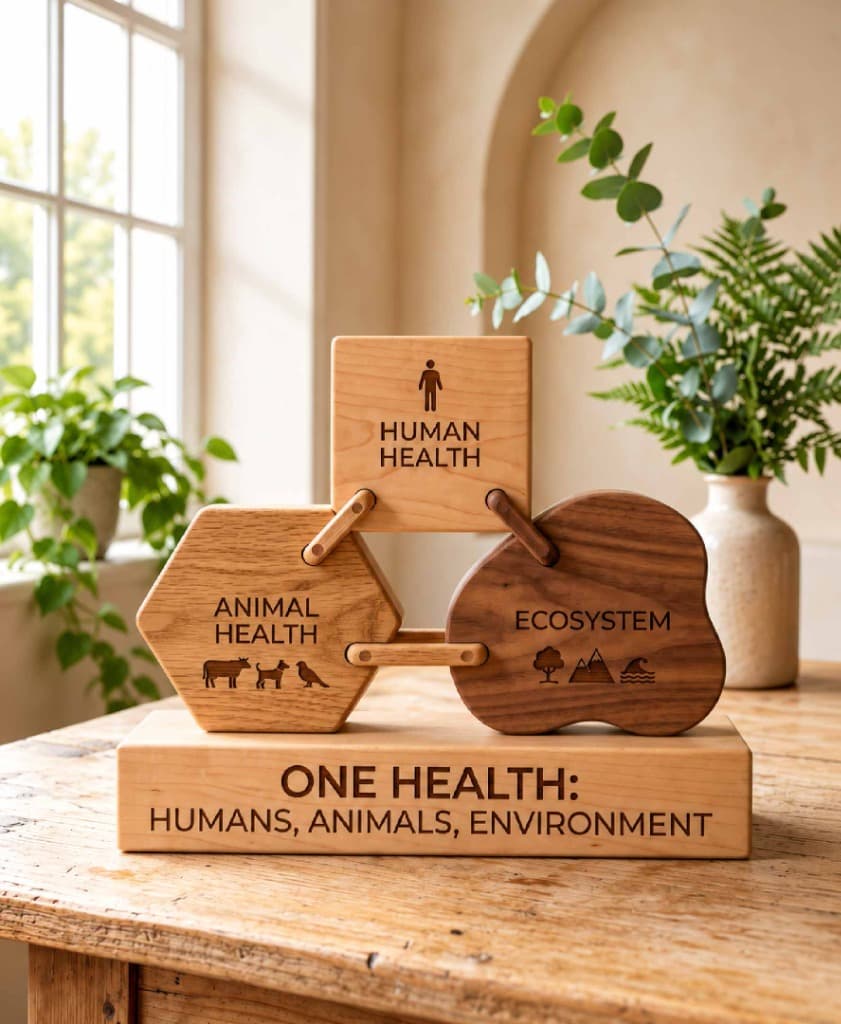
This is the central idea behind the One Health approach: health cannot be managed effectively by treating people, animals, plants and ecosystems as separate systems. The Food and Agriculture Organization of the United Nations (FAO) describes One Health as an integrated approach that aims to sustainably balance and optimize the health of people, plants, animals and ecosystems.
What Does One Health Mean in Agriculture?
In agriculture, One Health means looking beyond the farm as an isolated production unit. It means understanding how decisions made at one point in the food system can influence health outcomes elsewhere — from soil and water quality to livestock health, food safety and public health.
The approach brings together disciplines and sectors that have traditionally worked separately. Agronomists, veterinarians, food scientists, public-health professionals, environmental specialists, researchers, policymakers and industry can contribute different parts of the same picture. WHO notes that collaboration across sectors is particularly important for challenges such as infectious diseases, antimicrobial resistance and food safety.
1. Healthy Agriculture Supports Healthy Food
Food is one of the clearest links between agriculture and health. What happens during crop production, livestock management, processing and distribution can influence the safety and nutritional quality of food.
FAO describes food as sitting at the human–animal–plant–environment interface. Foods of plant origin and products such as meat, milk and eggs connect consumers directly to the conditions in which crops and animals are produced. Food-production environments can also influence animal and plant health, while pathogens or chemical contaminants can affect food safety.
A One Health perspective therefore encourages food safety to be considered across the entire chain — not only at the point of consumption.
2. Animal Health Is Closely Linked to Human Health
Livestock, poultry and other animals are an essential part of many agricultural and food systems. Their health affects productivity, livelihoods, food availability and, in some situations, human health.
Diseases can move between animals and people, while conditions on farms can influence how pathogens emerge, spread and are detected. Effective surveillance, biosecurity, vaccination where appropriate, responsible antimicrobial use and rapid information sharing can therefore have benefits beyond the farm.
WOAH emphasizes the interconnection between animal, human and environmental health and the importance of multisectoral collaboration in addressing emerging and re-emerging health threats.
3. Soil, Water and Environmental Health Matter Too
Agriculture depends on natural systems. Soil supports crops, water supports production and ecosystems influence the conditions in which agriculture operates. When these foundations are degraded, the effects can extend across the food system.
Soil health, water quality, biodiversity and responsible resource management are therefore not separate environmental concerns. They can influence crop productivity, animal health, food safety and the resilience of farming systems.
Recent FAO work on One Health in agrifood systems highlights these connections, including the relationship between degraded soil, crops and animal feed, and between poor water quality and pathogen transmission.
4. Antimicrobial Resistance Shows Why the Systems Cannot Be Separated
Antimicrobial resistance (AMR) is one of the clearest examples of a challenge that crosses sectors. Antimicrobials are used in human and veterinary medicine and can also be connected to agricultural and environmental pathways.
Managing AMR therefore requires coordination across human health, animal health, food production and environmental systems. A One Health approach supports this kind of coordinated prevention, surveillance and response rather than treating antimicrobial resistance as the responsibility of a single sector.
5. Food Safety Is a One Health Issue
Food safety provides another direct connection between agricultural practices and public health. Risks can arise at multiple points — including production, animal health, water, feed, processing, storage and distribution.
This makes prevention increasingly important. Instead of responding only after a foodborne problem appears, One Health encourages stakeholders to identify and manage risks across the food and feed supply chain. FAO specifically highlights the importance of applying a One Health approach to food safety across sustainable food systems.
6. What One Health Means for the Future of Agriculture
The practical value of One Health lies in moving from fragmented solutions to connected ones. For agriculture, that can mean designing research, policy and technology around the relationships between production, health and sustainability.
- Integrated surveillance: Linking information on crops, livestock, pathogens, food safety, water and environmental conditions.
- Stronger biosecurity: Using prevention, monitoring and rapid response to reduce risks across farms and supply chains.
- Healthier production systems: Connecting soil health, animal welfare, plant health and responsible resource use.
- Smarter research collaboration: Bringing agricultural, veterinary, food, environmental and public-health researchers together.
- Evidence-based policy: Developing policies that recognize how agricultural and health outcomes influence one another.
- Technology with purpose: Using data, diagnostics, sensors, AI and digital platforms to improve early detection, decision-making and coordination.
From Farm Health to Food-System Resilience
The future of agriculture will not be defined only by how much food can be produced. It will also be defined by whether food systems can remain safe, productive and resilient while responding to climate pressures, disease risks, resource constraints and changing consumer needs.
That requires a broader definition of agricultural innovation. Advances in precision agriculture, animal disease surveillance, food technology, biotechnology, regenerative practices and digital systems can create greater value when they are considered within the wider health ecosystem rather than in isolation.
FAO increasingly frames One Health as part of agrifood-system transformation, spanning sustainable agriculture, animal and plant health, food safety, antimicrobial resistance, food security, nutrition and livelihoods.
Why This Conversation Matters Now
Agriculture is becoming more interconnected with public health, environmental management, technology, investment and policy. The challenges are interconnected too. A disease event can disrupt production. A food-safety failure can affect consumer confidence and trade. Water stress can influence crops, livestock and communities. Environmental change can alter the conditions under which health risks emerge.
One Health provides a framework for seeing these connections earlier and acting across them more effectively. It does not replace specialized expertise; it connects that expertise around shared outcomes.
The Way Forward
A healthier agricultural future depends on collaboration. Researchers need to exchange evidence across disciplines. Policymakers need to connect agricultural, environmental and health priorities. Industry needs to translate science into scalable solutions. And technology needs to support better decisions across the food system.
Ultimately, One Health in agriculture is about recognizing a simple reality: the health of food systems is inseparable from the health of people, animals and the environments that sustain them.
Continuing the Conversation
These intersections — from agriculture and animal health to food systems, science, technology and policy — are central to the global conversations shaping the future of sustainable agriculture. GARCX brings together researchers, industry leaders, policymakers, innovators and practitioners to explore these cross-sector challenges and the solutions emerging around them.
Key Takeaways
- Agriculture, animal health, food safety, human health and environmental health are interconnected.
- One Health encourages collaboration across disciplines rather than isolated sector-by-sector action.
- Healthy soils, safe water, healthy animals and safe food are important components of resilient food systems.
- Food safety and antimicrobial resistance demonstrate why coordinated action is necessary.
- Research, policy, technology and industry collaboration can help translate the One Health concept into practical agricultural solutions.
References & Further Reading
- FAO — One Health
- FAO — One Health: Food Safety and Quality
- WHO — One Health
- WHO — One Health Fact Sheet
- WOAH — One Health
Frequently Asked Questions
One Health in agriculture is an integrated approach that recognizes the connection between human health, animal health, plant health, food safety and environmental health. It encourages researchers, farmers, veterinarians, food scientists, policymakers and other stakeholders to work together to build safer, healthier and more resilient food systems.
One Health is important because agricultural systems directly influence food safety, animal health, human health and the environment. Issues such as foodborne diseases, antimicrobial resistance, animal diseases, water quality and climate-related risks can cross traditional sector boundaries and require coordinated solutions.
Agriculture provides food and relies on animals, crops, soil and water. Diseases can move between animals and humans, while agricultural practices can influence food safety and environmental conditions. Managing these connections together can help identify risks earlier and support healthier food systems.
A One Health approach considers food safety across the entire food chain, from crop and livestock production to processing, distribution and consumption. It encourages early identification and management of biological, chemical and environmental risks rather than addressing problems only after they reach consumers.
Animal health is a key component of One Health because some diseases can move between animals and humans. Healthy livestock and poultry systems, effective biosecurity, disease surveillance and responsible antimicrobial use can contribute to safer food production and help reduce wider health risks.
Antimicrobial resistance is a One Health challenge because antimicrobial use and resistance can involve humans, animals, food systems and the environment. Addressing it requires coordinated surveillance, responsible antimicrobial use, prevention and collaboration across sectors.
Share :